Should the RCN be processed or exported?
Compare processing netback with the raw-export alternative after conversion costs, finance, logistics and risk.
2026 industry & investment report
Pre-launch access · Official launch 16 September 2026
Commercial conditions for competitive and sustainable domestic processing.
A 469-page evidence-based examination of what must be true for Nigerian cashew processing to create more risk-adjusted value than exporting the same raw cashew nuts.
Pre-launch pricing ends 15 September 2026.
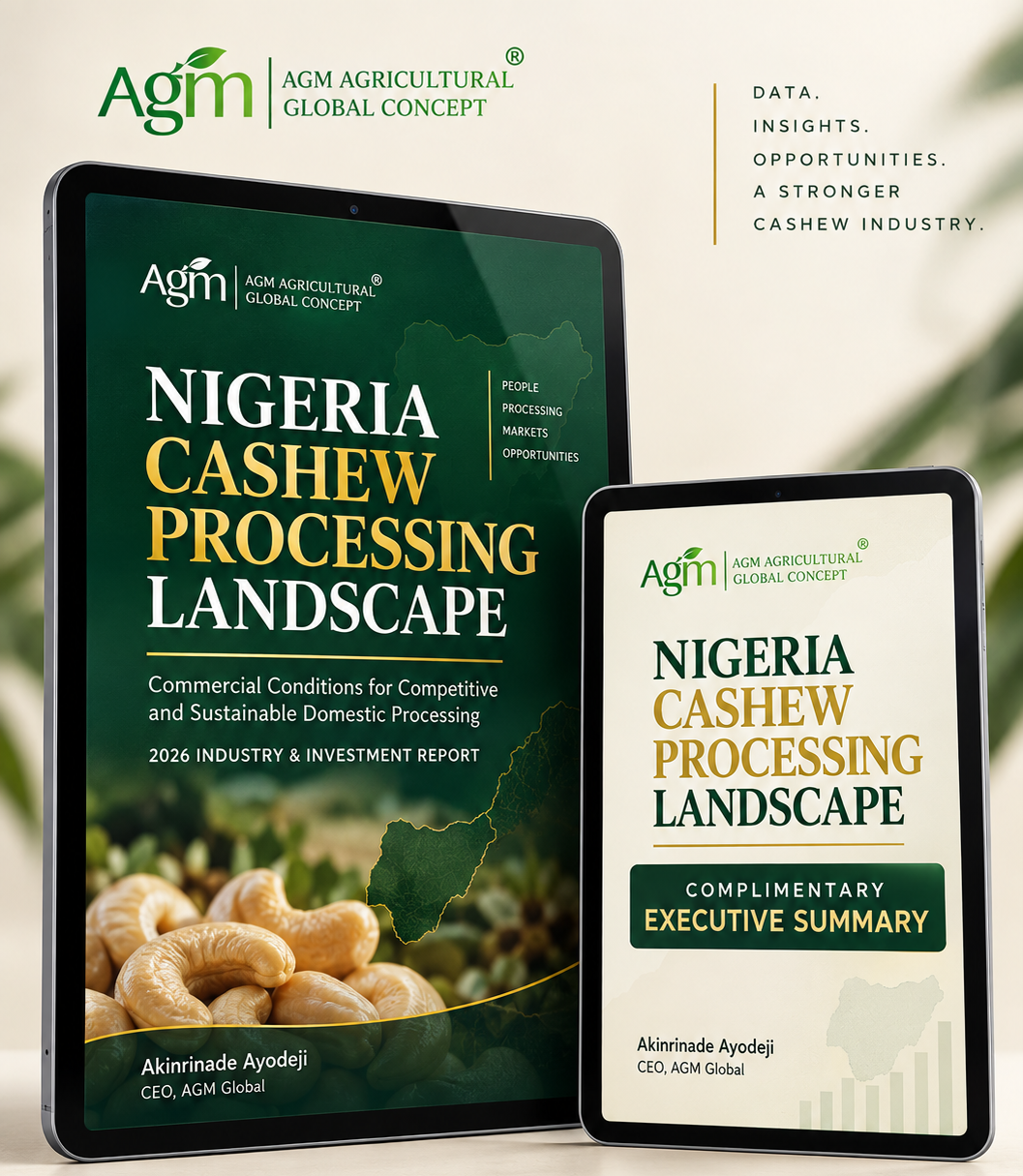
Professional digital editionDesigned for decisions—not shelf space.
469Evidence-led pages
20Commercial chapters
6Decision frameworks
13Executive-summary pages
The central proposition
Nigeria’s cashew-processing opportunity is not fundamentally a factory-building opportunity. It is a competitiveness-building opportunity.
The investment question must be solved from crop procurement to capital return.
What it helps you decide
The report treats the factory as one part of a wider commercial system—linking raw material, conversion, finance, markets, logistics and return.
Compare processing netback with the raw-export alternative after conversion costs, finance, logistics and risk.
Work backwards from recoverable kernel value to a quality-adjusted RCN ceiling price specific to the operation.
Test procurement, recovery, grade mix, utilisation, working capital and market realisation as one commercial system.
Original analytical frameworks
Use the frameworks independently or combine them into a structured processing-viability review.
Inside the complete report
From Nigeria’s starting position to processor economics, global benchmarks, due diligence and the final investment conclusion.
Nigeria’s processing starting position
RCN supply, procurement and crop economics
Workforce, productivity and factory organisation
Infrastructure, energy and the industrial ecosystem
Working capital, finance and the cash-conversion cycle
Export the RCN or process it?
Kernel markets, grade mix and offtake economics
Logistics, location and export economics
Policy, regulation, taxation and investment
Factory unit economics
Sensitivity, scale and capacity utilisation
CAPEX and investment returns
By-product economics
Why some processing origins scale
Nigerian processor failure and success analysis
Integrated industrial platforms
What must be true for processing to succeed?
Investor due-diligence checklist
Remaining data gaps and research agenda
Final conclusion
Who should read it
Complimentary executive summary
Receive the complete 18-page complimentary edition, including the report architecture, central commercial argument and six investment tests.
Beyond an individual purchase
Arrange corporate access, university or library use, bulk copies, association distribution or a private executive briefing.
Discuss institutional accessInvite Akinrinade for an investment discussion, project advisory engagement, conference, webinar, executive session or media interview.
Book a conversation
About the author
A Nigerian cashew value-chain operator, entrepreneur and industry researcher focused on the commercial systems connecting African agricultural origins to global markets.
His work spans raw cashew sourcing, origin procurement, commodity trade, processing analysis, plantation development, market intelligence and agricultural investment strategy.
Connect on LinkedIn ↗Frequently asked questions
The launch edition is digital. Qualified institutional and internal-distribution licences are available separately by enquiry.
The professional edition contains 469 pages, 20 chapters, analytical frameworks, commercial scenarios, benchmarks, investment tests and an investor due-diligence checklist.
No. It is designed for processors, investors, lenders, policymakers, development institutions, buyers, researchers and organisations evaluating Nigeria’s cashew value chain.
Internal distribution is available under an institutional licence. Individual purchases are licensed to the named buyer and should not be redistributed.
Yes. Executive briefings, advisory discussions, webinars, conferences, media interviews and project-specific conversations can be arranged separately.
Move from insight to decision
Financial scenarios are illustrative unless expressly identified as actual commercial data. Prospective investors should independently verify commercial assumptions before committing capital.